
When moving to a new house, the excitement is unmatched, but you’ve also got a lot to figure out in a new space. In this huge checklist, it is normal to miss out on some aspects, but you should never forget to check if the existing paint is lead-based or not.
However, your landlord is responsible for providing you with a Lead Warning Statement and mentioning any known lead-based paint at the property. But not everyone’s concerned about your wellness; thus, it’s your duty to ensure your house’s safety and learn how to identify lead paint.
Many Australian homes were painted with high amounts of lead, but its hazards to human health led to its eventual phase-out. Although it is no longer used, lead paint is still present in some older homes and may be dangerous to your health when it deteriorates. So, in this article, we will look at easy and effective ways to find out if your living space has any sign of lead paint and what you can do about it.
Why is lead paint dangerous?
Lead paint can break down into chips or dust that can be consumed or inhaled. Here are the common risk factors that may cause-
- Even lower levels of lead exposure can harm children’s brain development.
- It can lead to learning disabilities, behavioural problems, and decreased IQ.
- Pregnant women exposed to lead can experience miscarriage, premature birth, or developmental issues in their babies.
- Long-term exposure to lead can cause kidney damage, high blood pressure, and anaemia.
- Lead accumulates in the body over time, so even small exposures can add up to significant health risks.
How do I know if I have lead paint in my house?
Find out when your house was constructed
Because lead was inexpensive, long-lasting, and produced vibrant hues, it was commonly used in paint before the 1960’s. Due to its harmful effect on the human body, the percentage of lead in household paint decreased from 50% before 1965 to 1% that year. The percentage was lowered to 0.25% in 1992 and then to 0.1% in 1997. Currently, Australia is home to an estimated 3.7 million residences that were constructed before 1970, and most of them have lead paint, often with lead contents as high as 50%.
That’s why we suggest you find out all the details of the house you are moving into, including the year it was built. The chances of the house containing a higher percentage of lead are almost 9 out of 10 if the residence was made before 1960. Asking the previous owner, seller, or landlord might help you find out when your house was built.
Inspect areas with damaged paint
Another way to tell if paint is lead-based is to examine its condition. As lead-based paint degrades, lead dust is released, which is extremely dangerous to one’s health. So, it is wise to identify the signs of damage in your paint as early as possible. Also, inspecting damaged areas helps prioritise lead paint testing and makes it easy to determine the existence of lead. Understand the paint is decaying if it is-
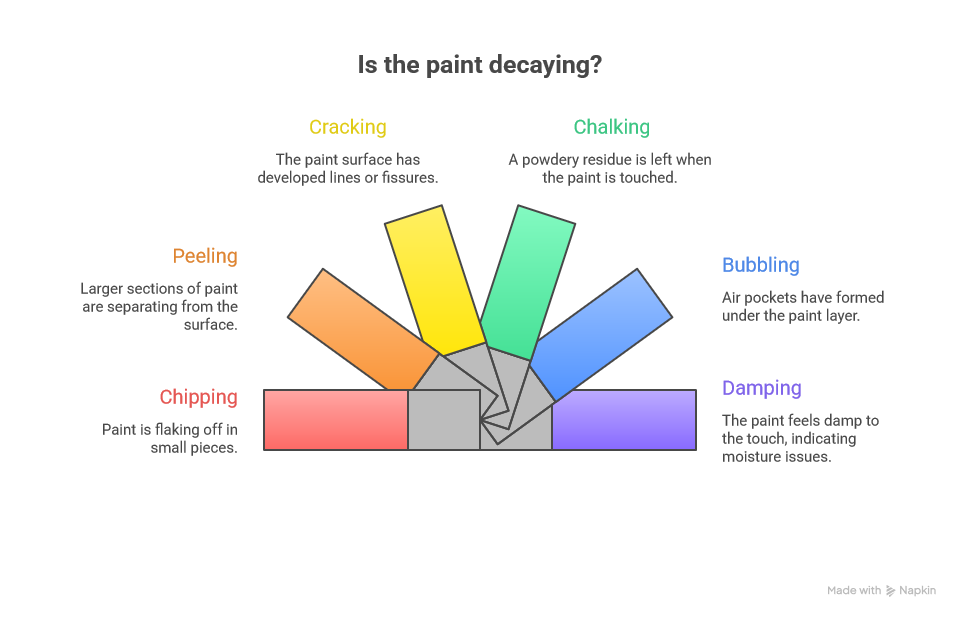
There is a deteriorating term called alligatoring when the cracking pattern resembles alligator scales. It is a common myth that alligatoring only happens in lead paint, which is not correct. However, it does suggest the paint is old, which often means it might contain lead.
Look for damaging signs in the paint inside your home and fix them instantly. Sometimes, even if the paint is not broken, high-risk surfaces with lead paint are equally dangerous. These types of surfaces are found in walls with high moisture or areas with frequent frictional contact. So, you need to be careful about these areas too.
Look underneath the newer layers of paint
Noticing several coats of paint, particularly in older structures, is another clue that the paint may contain lead. If you’re researching how to identify lead paint without kit testing, check for multiple paint layers. Some choose to paint over existing paint since stripping it off may be laborious. So, lead-based paint might be hiding underneath newer layers. If you suspect or are concerned about lead paint dangers, even if the surface may appear to have a fresh, clean layer of paint, it may be worthwhile to investigate more.
Damaged areas often expose underlying layers, revealing the potential presence of lead-based paint. You may discover layers of paint below, particularly in areas where the paint is already peeling. These are outdated coatings that were painted over for remodelling or repair.
Identify the lead symptoms
Another technique to spot lead paint is to recognise the early signs of lead poisoning. Young children and pregnant women are more at risk than others, so early symptoms are usually found in them. However, there is no one distinct sign of lead poisoning; instead, it can manifest itself in a variety of ways, many of which are generic.
Here, we’ve gathered a list of a few common early symptoms so that if you find any of these, you can see the dangers of lead at an early stage.
- Unexplained discomfort or cramping in the stomach area
- Joint pain or muscle aches
- Slurred speech or hearing problems
- Persistent tiredness or lack of energy
- Irritability, mood swings, or aggression
- Loss of appetite or unexplained weight loss
Try Lead testing kits at home
If you suspect that lead paint is present in your home, you should determine whether the paint is a concern and ensure that it is removed appropriately. You may test the paint in your house for the presence of lead in a few different ways:
- Colour-changing test kit
These kits may be purchased extensively at hardware and paint stores. While lead concentrations above 0.5% should be detectable by these test kits, they are not always reliable and can occasionally yield false negatives or, less frequently, false positive results.
- DIY sample kit
Sample kits are made to let you gather samples of paint, dirt, dust cloths, rainfall, and other materials to see if your house is child-safe. For accurate testing, the samples you collect are submitted to a laboratory registered with the National Association of Testing Authorities (NATA).
- A portable XRF machine
The lead content of paintings, toys, jewellery, and other items can be quickly and accurately determined using this equipment, but you’ll need to hire an expert to conduct the test for you.
What should you do if you find lead paint?
If you finally identify lead in your house paint, you have to enclose, encapsulate, or remove the paint from your property. There is a common concern regarding it, which is-
Can I just paint over lead paint?
One of the accepted methods for addressing lead paint dangers is “encapsulation,” which includes painting over lead paint. But to do this, you need to employ an “encapsulant,” a unique substance.
Lead paint cannot be securely contained with standard store-bought paint alone. The items below are not encapsulants:
- A fresh layer of primer or paint
- Wall covers with paper
- Contact paper
Encapsulating lead paint requires sealing and coating the previous layer of lead paint permanently to render it safe. So, it’s better to call professional painters in Sydney who include these painting services in their company.
Moreover, as lead is a hazardous substance, removing lead paint yourself is not a good idea. Professional lead based paint removal requires strict safety procedures to protect your household and the surrounding environment. While lead paint removal is a specialised service available across Australia, you should trust only the qualified experts.
Conclusion
In Conclusion, we must say that the presence of lead paint doesn’t automatically guarantee lead poisoning, but taking proactive steps is essential to ensure a healthy living environment. By understanding the risks, inspecting your home thoroughly by yourself or the professionals, and taking appropriate action.
For safe, compliant lead paint removal in Sydney, homeowners can seek help from an experienced painting company like Priority One Coatings for a risk-free experience. Thus you can prevent lead exposure and create a safe haven for you and your family.