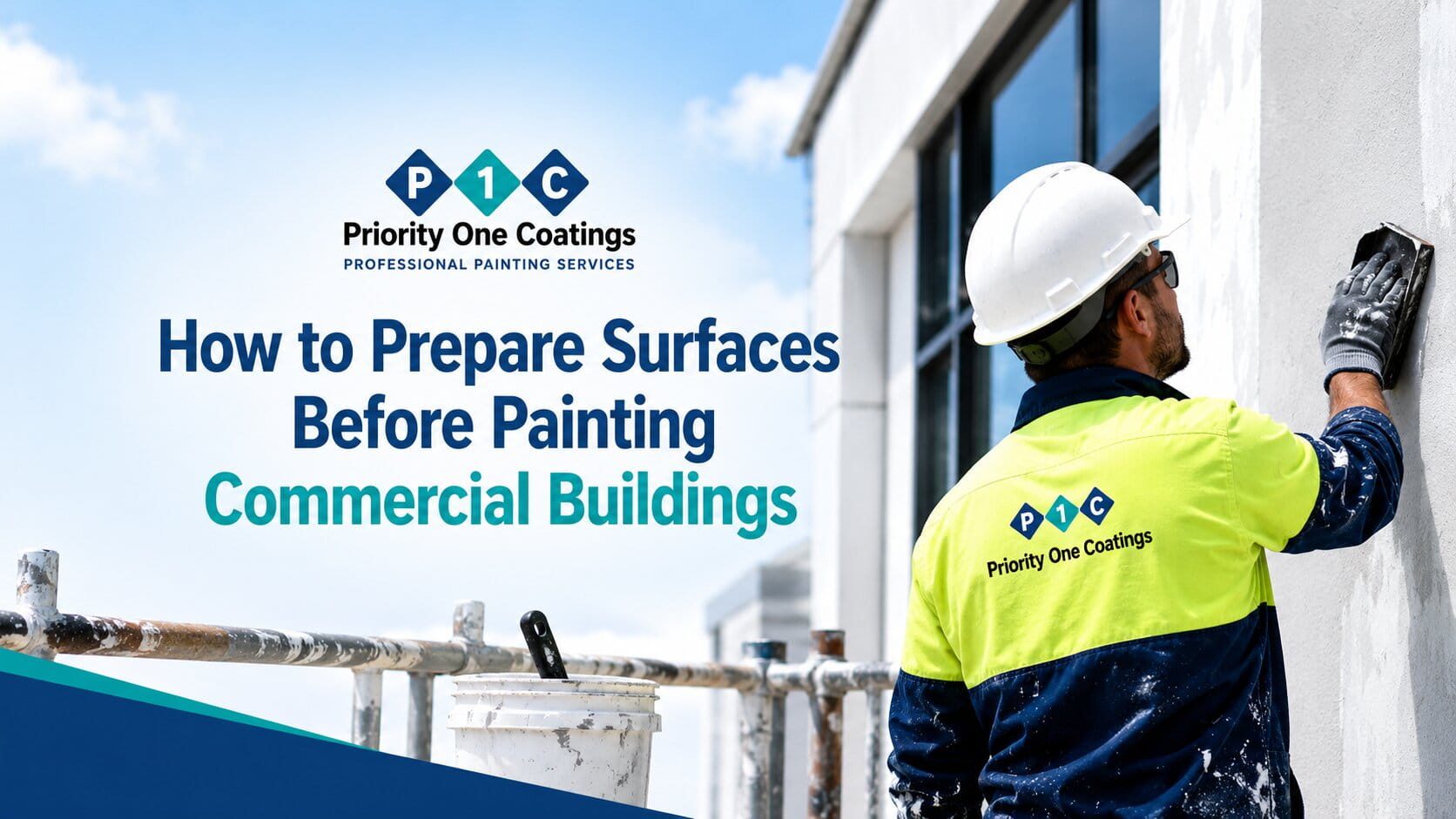
Walk into any office tower, warehouse or shopping centre with peeling walls, and you are almost never looking at a paint problem. You are looking at a preparation problem. Paint is only as good as the surface underneath it, and in a commercial building — where walls take constant knocks, where compliance and downtime matter, and where a repaint may need to last a decade — that surface does a lot of heavy lifting.
Experienced commercial painting contractors will tell you the same thing: the roller is the easy part. The real work happens before a single tin is opened. This guide walks through how surfaces are properly prepared for painting in commercial buildings, why each stage matters, and what separates a coating that holds for years from one that starts flaking after the first wet winter.
At Priority One Coatings, surface preparation forms an important part of our approach to professional painting. For commercial property managers, facility managers and business owners, working with professional commercial painters in Sydney can help ensure preparation is completed systematically, and the coating system is appropriate for the building.
Why Surface Preparation Decides the Life of a Commercial Paint Job
Paint adheres mechanically and chemically to whatever it touches. If it touches dust, grease, chalky old coatings, salt deposits or moisture, it bonds to those contaminants instead of the substrate — and it will eventually let go, taking your investment with it. Industry estimates consistently attribute the large majority of premature coating failures to inadequate preparation rather than to the product itself.
In a commercial setting, the stakes climb higher. For a large commercial project, this matters financially as well as aesthetically. A failed coating in a hospital corridor, a school stairwell or a retail frontage means repeat access, repeat scaffolding, repeat trade coordination and repeat disruption to tenants or staff. That is why any credible commercial painting company in Sydney will spend a genuine share of the project timeline on preparation, and why a quote that skips straight to “two coats applied” is usually a quote worth questioning.
Start with a Thorough Site Inspection and Substrate Assessment

Preparation begins with looking, testing and asking questions. A proper inspection identifies what each surface actually is — plasterboard, cement render, fibre cement sheet, structural steel, galvanised metal, concrete tilt panel, brickwork or previously coated timber — because every substrate demands a different approach.
At the same time, the assessment looks for underlying defects that painting will not fix and may even hide until they worsen. Rising damp, roof or window leaks, efflorescence pushing through masonry, rusting reinforcement, mould behind fixtures, delaminating render and previous coatings that have lost adhesion all need to be resolved before any preparation work continues. Adhesion and moisture testing help here: a simple tape or cross-hatch test reveals whether the existing coating is sound enough to overcoat. In contrast, moisture readings confirm whether new concrete or render has cured sufficiently to accept paint. New masonry and concrete typically need weeks of curing, and applying a coating too early traps moisture and alkalinity behind the film.
For older buildings across Sydney, this stage also determines whether hazardous materials are present. Anything built or repainted before the 1970s may carry lead-based paint. When paint contains lead levels greater than 1%, strict safety steps, licensed lead paint removal experts, and specialised containment controls are required. This stops toxic dust from spreading during surface preparation and ultimately protects your health.
Protect the Building and the Occupants
Once the substrates are understood, the site itself gets prepared. Commercial buildings rarely empty out for a repaint, so protection and sequencing become part of the preparation work rather than an afterthought. Furniture, plant, stock, IT equipment and fixtures are moved or covered, floors and finished surfaces are masked and drop-sheeted, and access equipment such as scaffolding, elevated work platforms or swing stages is set up in line with a site-specific safety plan.
Signage, dust containment, ventilation and exclusion zones matter just as much. Sanding and mechanical abrasion generate airborne dust; solvents and some primers carry odour and VOC considerations that need managing in occupied environments like aged care facilities, childcare centres, medical suites and food premises. This is also where scheduling is agreed — many commercial projects are staged after hours, overnight or across weekends so that trading and operations continue uninterrupted. Priority One Coatings works this way routinely, and it is one of the reasons building managers keep our commercial painters in Sydney on their preferred contractor lists.
Remove Loose, Peeling or Failing Paint

Existing paint should not automatically be considered a suitable base for another coat. Loose, peeling, blistered or poorly adhered coatings need to be addressed before repainting. If unstable material remains underneath, the new paint may adhere to the failing coating rather than the actual substrate. The result can be premature failure of both layers.
The extent of removal depends on the condition of the existing coating. Some areas may only require localised preparation, while extensively deteriorated surfaces can require more substantial remedial work.
Older buildings can also require additional caution because historical coatings or substrate conditions may present hazards. Priority One Coatings provides lead paint testing and removal in Sydney among its commercial painting services, which is particularly relevant where older coating systems may be present.
Repair Cracks, Holes and Surface Defects, Then Sanding
With clean, sound surfaces, the repair stage begins. Cracks are raked out and filled, nail pops and screw heads are treated, damaged plasterboard is patched, holes and chips are made good, and joints are re-caulked with a flexible sealant where movement is expected. On rendered and masonry surfaces, hollow or drummy sections are cut out and re-rendered. On steelwork, rust is removed back to sound metal by wire brushing, grinding or abrasive blasting depending on the degree of corrosion, then treated promptly so flash rusting does not undo the work. Timber requires attention to rot, splits and previously exposed grain.
Sanding follows repairs, and serves two purposes at once. It levels fillers and patches flush with the surrounding surface so the finish reads as one plane under commercial lighting, and it abrades glossy or aged coatings to give the new paint a mechanical key to grip. Enamel doors, frames, handrails and previously gloss-painted walls all need this dulling down. Where sanding cannot achieve enough adhesion — on tiles, laminates, powder-coated metal or dense concrete — mechanical abrasion or a bonding primer takes over. Then remove all sanding dust by vacuuming and wiping, because dust left on the wall becomes the layer your paint actually sticks to.
Prime and Seal to Suit the Substrate

Priming is the bridge between preparation and finish, and the choice of primer is where technical knowledge shows. Bare plasterboard needs a sealer to even out porosity so the topcoat doesn’t flash or patch. Fresh render, concrete and masonry generally require an alkali-resistant sealer to handle high pH. Bare or newly cleaned steel needs a corrosion-inhibiting primer, while galvanised and non-ferrous metals need an etch or specialised bonding primer. Timber calls for a wood primer with stains and knots spot-sealed to stop bleed-through, and heavy water stains, nicotine or graffiti usually need a stain-blocking sealer regardless of substrate.
Patch-primed repairs should also be spot-primed rather than left raw; otherwise, those areas absorb differently and remain visible through two topcoats. Getting this stage right is a large part of why a coating system performs as the manufacturer intended — something we take seriously as Dulux Accredited and Master Painters Australia members. You can see how this discipline translates into finished results across our recent commercial projects.
Choose the Correct Primer for the Substrate
Primer is not a universal product that can be applied identically to every surface. Different substrates and existing coatings may require specific primers or undercoats to achieve appropriate adhesion and performance. Raw timber, masonry, fibre cement, plasterboard and metal can all have different requirements.
For example, raw weatherboard requires an appropriate primer before finishing coats are applied. Previously painted weatherboard may also require identification of the existing coating system so that a compatible primer and new coating can be selected.
This is an area where professional product knowledge becomes particularly important. Choosing a coating system based only on colour or price can be a false economy if it is incompatible with the substrate. An experienced commercial painting company should assess the environment and surface before specifying primers, undercoats and finishing products.
Prepare Different Commercial Surfaces Correctly

Before preparation begins, inspect the building to establish what is actually being painted and its current condition. A commercial property can contain numerous substrates within the same project. Internal areas may include plasterboard, timber doors and frames, masonry and previously coated surfaces. Exteriors can introduce rendered masonry, concrete, fibre cement, timber, steel and other materials.
There is no single preparation process that works for every part of a commercial building.
Plasterboard and Gyprock
Plasterboard and gyprock generally need properly finished joints and fixing points, sanding, dust removal and an appropriate sealer or primer before finishing coats.
Timber
Timber may require filling, sanding, cleaning and priming. Existing timber coatings should also be assessed for their condition and compatibility with the proposed new system.
Rendered Masonry and Concrete
Rendered masonry and concrete need to be clean, sound and appropriately cured. Contamination and curing compounds may need to be removed before priming.
Fibre Cement
Fibre cement sheets require suitable patching and cleaning. Previously coated sheets should also be checked for deteriorating paint, dirt and mould.
Metal Surfaces
Metal surfaces can require a different preparation regime again, particularly where corrosion or specialist protective coatings are involved.
This substrate-specific approach is one reason professional surface preparation is so important on larger commercial painting Sydney projects. A building may require several preparation techniques and coating systems within one scope of works.
The Mistakes That Cost Building Owners the Most
The most expensive errors are almost always shortcuts. Painting over moisture or before render has cured. Skipping the wash because the wall “looks clean.” Overcoating a failing coating instead of removing it. Choosing a general-purpose primer for a specialised substrate. Working outside the temperature and humidity range the manufacturer specifies — a real consideration while painting in a Sydney winter, when surfaces stay cold and dew forms early. Each of these saves a few hours and costs a few years of coating life.
Frequently Asked Questions
How long should surface preparation take on a commercial project?
It varies with the condition of the building. Still, preparation commonly accounts for a substantial share of total project hours — often more than the application itself on older or heavily trafficked buildings. A newly built fitout with clean plasterboard needs far less than a 30-year-old warehouse with rust and chalking render.
How do you keep dust and disruption down in an occupied building?
Through containment, ventilation management, staged work zones and flexible scheduling. Most of our commercial painting Sydney projects are programmed after hours or across weekends so tenants, staff and customers are not affected.
Do you handle floors and specialised coatings as well as walls?
Yes. Concrete floor preparation involves grinding or diamond polishing, moisture testing and crack repair before an epoxy floor coating is applied, and we also deliver full commercial fitout painting and strata painting services.
How long does surface preparation take?
There is no standard timeframe. A relatively sound office interior may require considerably less preparation than an ageing exterior with damaged coatings, detailed timberwork or difficult access. Substrate type can also affect project duration, with detailed surfaces generally requiring more labour than broad wall areas.
Why use professional commercial painting contractors?
Commercial projects can involve multiple substrates, specialist coatings, access requirements, occupied workspaces and tight schedules. Experienced contractors can assess these factors together and establish a preparation and painting process suited to the property.
Prepare Your Commercial Property for a Better Painting Result

A durable commercial paint finish begins with preparation. Cleaning, repairing, sanding, treating damaged coatings and selecting the correct primer are not optional details — they are fundamental parts of producing a professional result.
If you are planning a repaint, refurbishment or ongoing maintenance program, Priority One Coatings can assess your building and recommend an appropriate painting solution. Our experienced, Dulux Accredited team provides professional painting services in Sydney, including interior and exterior painting, high-access work, spray painting, epoxy and floor coatings, maintenance programs and other specialist painting services.
Whether you manage an office, retail facility, educational property, healthcare building or another commercial site, speak with Priority One Coatings about preparing and painting your property properly from the start.
Ready to Get Surface Prepared Properly? Talk to Priority One Coatings
If you are planning a repaint, a fitout or a maintenance program, our team will inspect the substrates, identify what needs to happen before the first coat, and give you a clear, honest scope and quote.
Call Priority One Coatings on 02 9808 5900, email jenny@prioritycoatings.com.au, or request a free quote online and find out more about our full range of Sydney painting services.